Guides
Boiler glossary: terms explained
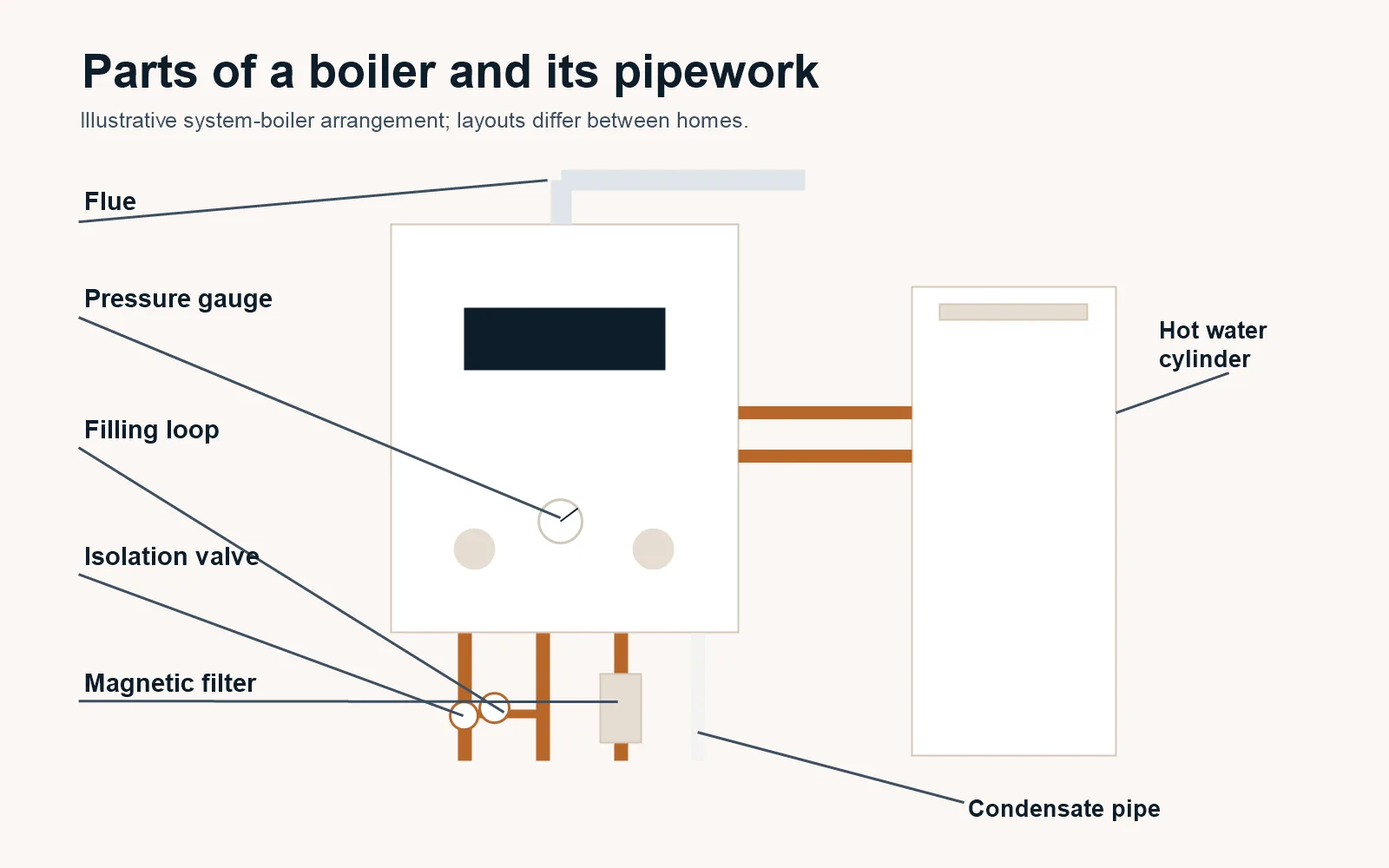
This boiler glossary explains the terms you will meet on a quote, in a manual or on a boiler’s display, in plain English. It is grouped by what you are trying to do: choose a boiler, understand the parts, read an efficiency claim or deal with a fault. Use the boiler terms below as a checklist when you read a quote. Each entry says what the word means and, where we have written about it, links to the guide that goes further.
Boiler glossary: types of boiler
Combi boiler. A boiler that heats the radiators and makes hot water on demand, with no hot water cylinder. It suits smaller homes, and it is often the least expensive kind. See gas combi boilers.
System boiler. A boiler that heats the radiators and stores hot water in a separate cylinder, so several taps can run at once. See system boilers.
Regular boiler. Also called a heat-only or conventional boiler. It works with a cylinder and two extra tanks, usually in the loft. See regular boilers.
Condensing boiler. A boiler that captures and reuses heat from the gases that would otherwise escape through the flue. A plastic flue and a plastic drain pipe are two signs of one. Our guide to boiler efficiency ratings explains how to tell.
Hot water cylinder. The tank that stores hot water for a system or regular boiler. A combi doesn’t need one.
Header tank. A cold water tank, usually in the loft, that a regular boiler needs. The Energy Saving Trust says a regular boiler has two extra tanks of this kind.
Parts and pipework
Flue. The pipe that takes fumes out of the boiler and brings fresh air in. A longer or moved flue adds to the cost of a job.
Condensate pipe. The plastic pipe that carries the water a condensing boiler makes to a drain. In cold weather an outdoor one can freeze, and that stops the boiler. See Vaillant F28.
Filling loop. The short connection used to top up the water in a sealed heating system. Your manual shows where it is. See Vaillant F22.
Pressure gauge. The dial on the boiler showing the water pressure in the system, in bar. Vaillant and Ideal both give a normal range of 1 to 1.5 bar.
Isolation valve. A valve that shuts off the supply to the boiler. On an Ideal boiler, the gas isolation valve is yellow, and it must be open for the boiler to light. See Ideal L2.
Thermostatic radiator valve. A valve on a radiator that controls how hot that radiator gets. Installers often fit them with a new boiler.
Boiler glossary: efficiency and standards
Energy label. The label that rates a boiler from A+++ down to G. A gas boiler can reach class A at best.
Seasonal efficiency. The measure behind the label: how well a boiler turns energy into heat over a heating season.
Boiler Plus Standards. The rules in the English Building Regulations that set the minimum efficiency for a new gas boiler, described by the government as 92%.
Output. How much heat a boiler can produce, in kilowatts. The right output depends on the home, and an installer should size it. See combi boiler models.
Boiler glossary: faults and safety
Fault code. A short message on the display saying what has stopped the boiler. The code is the maker’s own, so the same number can mean different things on different makes. See boiler fault codes.
Lockout. The boiler shutting itself down after a failed attempt to light. Ideal’s L2 is a lockout.
Reset. Clearing a lockout or a fault from the boiler’s controls, as the manual describes. A reset often clears a fault, but repeating it doesn’t fix the cause.
Pre-payment meter. A gas meter that you top up with credit. If the credit runs out, the gas stops and the boiler can show a fault.
Gas Safe Register. The official list of engineers allowed to do gas work. See the Gas Safe Register guide.
Gas Safe ID card. The card an engineer carries that lists what gas work they are qualified to do. Check both sides before work starts.
Carbon monoxide alarm. An audible alarm that warns of carbon monoxide, which is one of the risks of unsafe gas work. Gas Safe recommends one around the home.
Where to go next
If a term on a quote still isn’t in this boiler glossary, ask the installer to explain it in writing, and put quotes side by side with our compare tool. We add to the glossary as new questions come in. Our boiler advice page links to every guide, and you can get free quotes from Gas Safe installers when you are ready.
Sources: the Energy Saving Trust, Vaillant, Ideal, Gas Safe Register and GOV.UK pages linked in the guides above, read on 3 November. See Energy Saving Trust, Boiler types explained.
Vaillant is a trade mark of its owner. CombiBoiler.net is independent and is not affiliated with, sponsored or endorsed by any manufacturer. We name brands only to help you compare like with like; see how we make money.
Get quotes for your home
A guide price only takes you so far. Local firms can price the work on your own home, and comparing a few quotes is the quickest way to see what is reasonable.
Compare free quotes